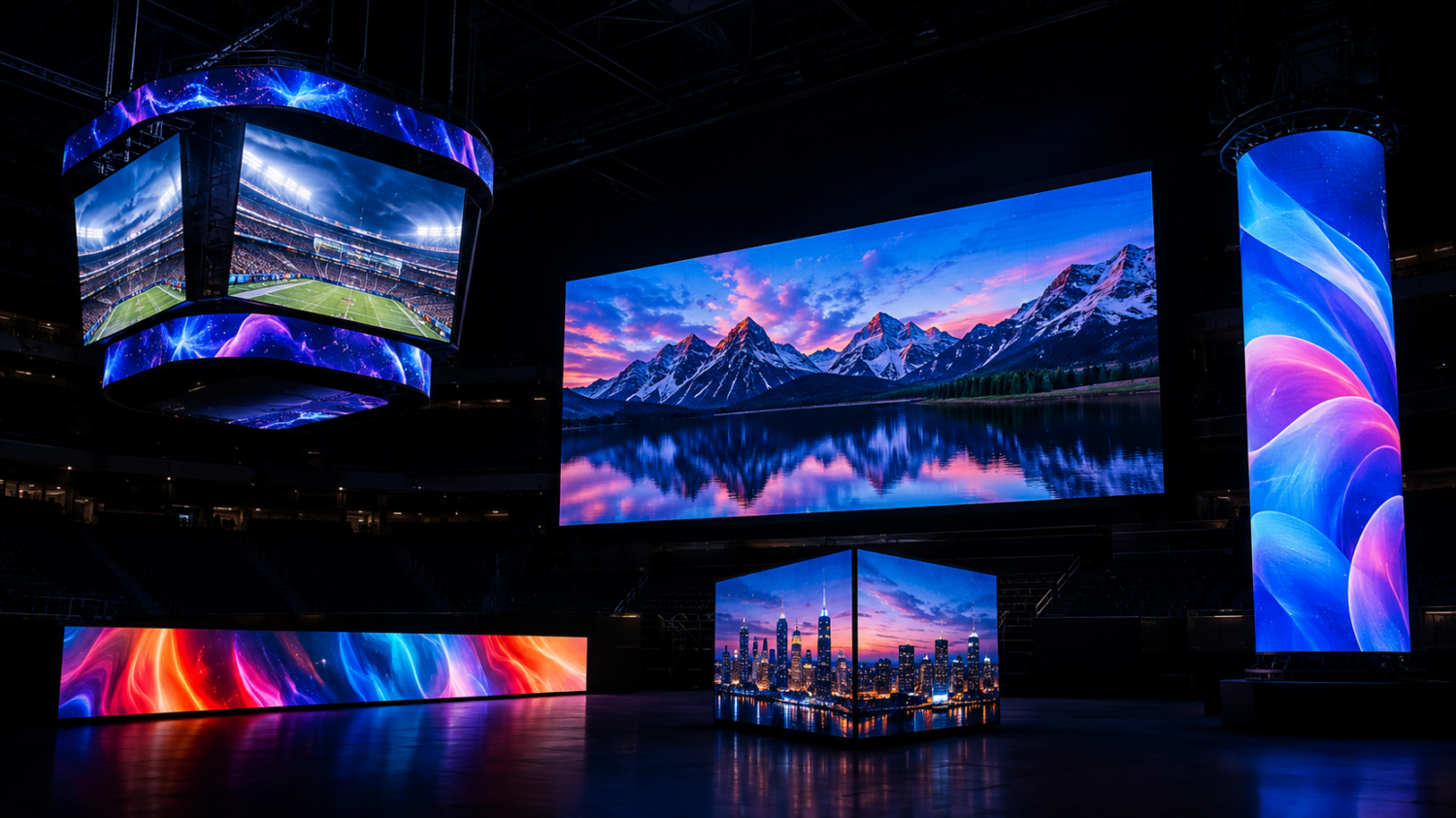
Few things command a crowd like a giant screen. Whether you’re running a stadium event, a tournament, a festival, or a community game day, a jumbotron screen turns a large space into a shared experience. Everyone sees the replay, the score, the sponsor message, and the reaction shots in real time.
Today’s jumbotrons look nothing like the early versions that started the trend. Most are now built from modular LED video wall panels, so they can be sized, shaped, and even rented for the events you need. This guide covers:
-
- What a jumbotron screen is
- Is a jumbotron the same as an LED screen?
- How an LED jumbotron is assembled
- Jumbotron Use cases: sports stadiums, concerts, advertising, and more
- Jumbotron rental: when it makes sense to rent a jumbotron
- Jumbotron cost: what goes into the price
- How to choose the right LED jumbotron
What Is a Jumbotron Screen?
A jumbotron screen is a very large video display built to show live action, replays, graphics, statistics, and advertising to a big audience from a long distance. The name began as a Sony brand. The company introduced its large-format video display in the early 1980s, with the first one installed at Dodger Stadium in Los Angeles, and the word stuck as the everyday term for any oversized venue screen.
Those first displays were built on cathode-ray tube technology. They were groundbreaking for the time, but they struggled with resolution and brightness, and they were expensive and heavy. LED technology changed all of that. Modern LED displays are brighter, lighter, more energy efficient, and more durable, and they can be built in virtually any dimension. That shift is why the jumbotron went from a rare stadium feature to something you can find at high school fields, festivals, shopping districts, and corporate events.
Is a Jumbotron the Same as an LED Screen?
People use the terms interchangeably, but they describe different things. “Jumbotron” tells you about the scale and purpose of a screen: a massive display meant for a mass audience. “LED screen” tells you about the technology behind it. A modern LED jumbotron is simply a large-scale LED screen designed to show high-quality visuals to a crowd.
In practice, that means when you shop for a jumbotron today, you’re really shopping for an LED video wall: the panels, the structure, the processing, and the crew that makes it all work together.
How a Jumbotron is Assembled
One of the biggest advantages of an LED jumbotron is modularity. Here’s how a jumbotron screen comes together from LED video wall panels:
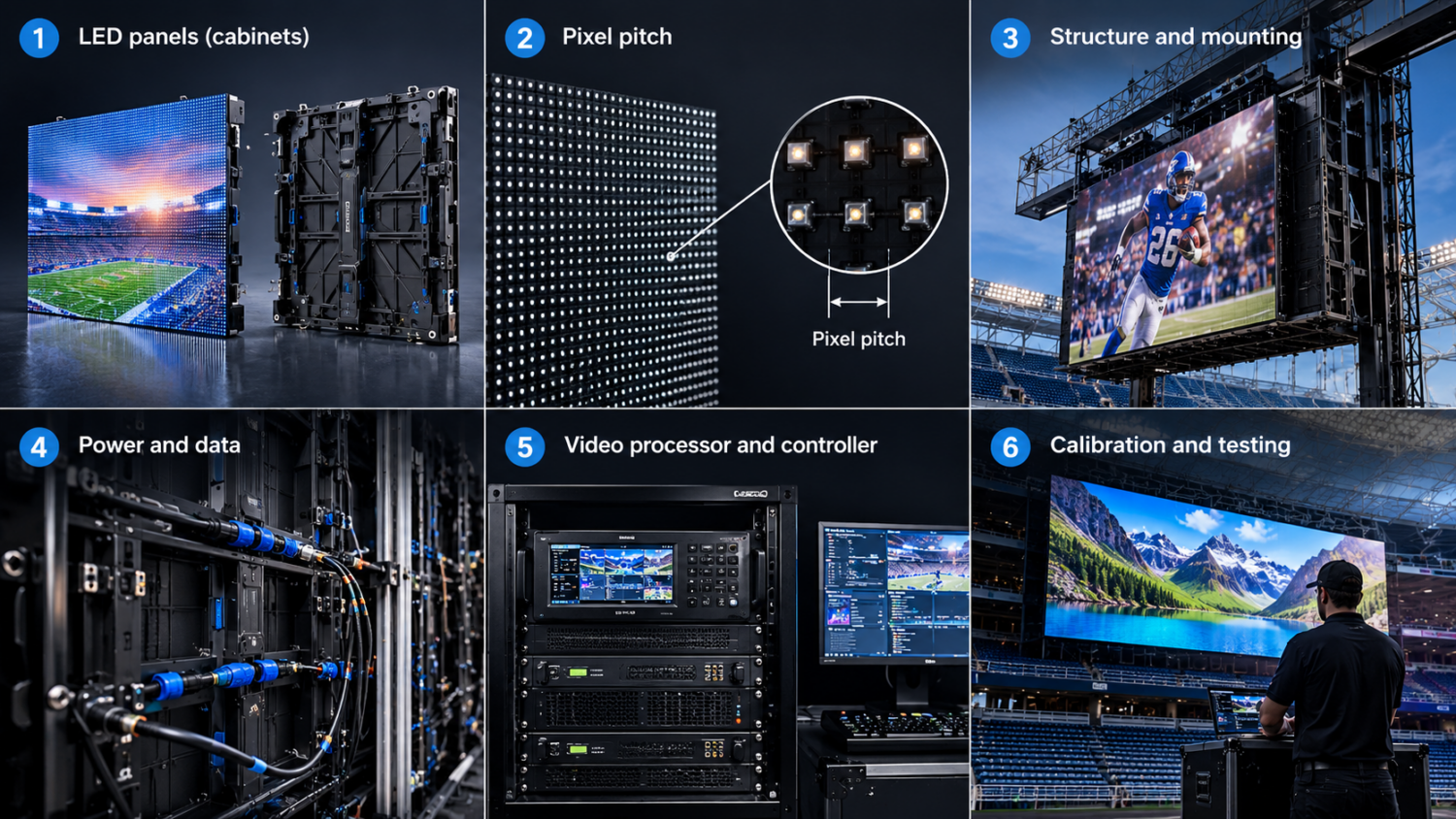
- LED panels (cabinets) – The building blocks are individual panels, typically in standard sizes that snap together edge to edge. The number of panels you stack, wide and tall, sets the overall screen size and aspect ratio. Want a wide 16:9 board for a stadium concourse, or a tall, narrow one for a scoring tower? You can design either from the same panel family.
- Pixel pitch – This is the distance between LEDs on the panel. A smaller pitch means a sharper image. Farther viewing distances, like the upper deck of a stadium, allow a larger pitch, while closer audiences call for finer detail. A good rule of thumb is that the pitch in millimeters roughly matches the minimum comfortable viewing distance in meters.
- Structure and mounting – Panels are joined to one another with quick-lock hardware and mounted on a support system. Depending on the venue, that may be ground-stacked on a frame, flown from truss or rigging, or fixed to a wall or steel structure. For outdoor venues, wind loading and weight distribution need careful engineering.
- Power and data – Each panel needs power and signal. Power is distributed in zones, and data is daisy-chained or run through network and fiber cabling. Good design includes redundancy, so one failure doesn’t take down the whole screen mid-game.
- Video processor and controller – This is the brain of the wall. The processor takes your sources (a live camera feed, a replay server, a graphics system, or a laptop) and maps them across every panel so the image looks like a single display.
- Calibration and testing – Before doors open, technicians calibrate brightness and color across the whole wall so panels match, then test content, signal paths, and backups.
The result is a display you can scale up, reshape, or rebuild for the next event. Explore indoor and outdoor LED options to see the panel types available.
Jumbotrons Use Cases
Jumbotrons were created to get visuals in front of huge audiences, and they remain most valuable wherever hundreds or thousands of people gather.
Stadium Jumbotron for Sports
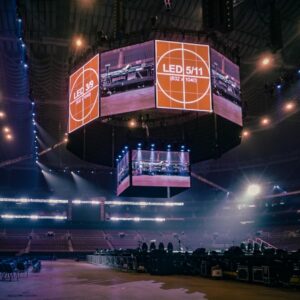
A stadium jumbotron for sporting events is often the centerpiece of the fan experience, and its size means fans in every seat can see it. It carries the live action and instant replay, so fans can follow the play, catch the close call again, and feel part of the broadcast, while real-time scoreboards, stats, and game clocks keep the crowd oriented and engaged. The same screen creates premium inventory for sponsorship and advertising, giving sponsors a high-visibility home for content and promotions, and it drives fan engagement through crowd cams, contests, and social media walls that keep energy high during breaks in play. Beyond permanent installations, jumbotrons are just as valuable at temporary and secondary venues, where tournaments, outdoor watch parties, and high school and college events often need a big screen without a permanent build.
Concerts and Festivals
At music and cultural events, large LED screens let everyone enjoy the show regardless of where they’re standing. High-resolution visuals and live camera feeds bring the stage to the back of the crowd and add to the production itself. See our concert and festival solutions for more.
Outdoor Advertising
In digital out-of-home (DOOH) advertising, large LED displays work as dynamic, flexible billboards. Their brightness keeps content visible in direct sunlight, and messages can change instantly, making them a strong fit for campaigns that need to grab attention.
Urban and Commercial Spaces
City centers, entertainment districts, and shopping destinations use large-format LED screens for promotions, news, entertainment, and interactive content. In these settings, a jumbotron screen helps turn public space into an engaging destination for visitors.
Jumbotron Rental: When It Makes Sense to Rent a Jumbotron
Buying a permanent display is a major capital investment. For one-time events, seasonal needs, or venues testing what works, jumbotron rental is often the smarter route. When you rent a jumbotron, you typically get:
- Lower upfront investment – You pay for the days you need instead of owning the hardware.
- Delivery, setup, and teardown – Experienced crews handle the build and takedown.
- Technical support – On-site technicians can monitor the screen throughout the event.
- Flexibility – Need a bigger wall for the championship game than for the regular season? Rentals scale with the event.
- Current technology – You get equipment that’s maintained and ready to run, without worrying about storage or upkeep.
Rentals work for stadium overlays, tournament weekends, outdoor watch parties, festivals, and promotional activations. Browse our LED wall rental options to see what’s available for rent, or use the LED calculator to estimate the panels needed for your wall.
Jumbotron Cost: What Goes into the Price
Jumbotron cost varies widely because no two builds are alike. A screen for a small tournament and a screen for a full stadium may share the same underlying technology, but they call for very different amounts of hardware, labor, and planning. Whether you’re comparing jumbotron rentals or considering a purchase, these are the main factors that shape the total:
- Screen size – More panels mean more hardware, more rigging, and more labor to build and take down.
- Pixel pitch and resolution – Finer detail requires more LEDs per square foot, which raises the cost of the display.
- Indoor vs. outdoor – Outdoor panels need higher brightness, weather protection, and often stronger structural support.
- Brightness and performance needs – Daylight events and long viewing distances call for more powerful panels than a dim indoor arena.
- Rental duration or ownership – Multi-day rentals often make more sense per day than one-day builds, while a permanent installation follows a different cost model altogether.
- Structure and installation method – Ground-stacked, flown, or custom-shaped builds require different hardware, engineering, and crew time.
- Power and infrastructure – Venues without adequate power may need distribution equipment or generators.
- Delivery and logistics – Distance, site access, and load-in and load-out schedules all affect the scope.
- Crew and technical support – On-site technicians and operators keep the screen running through the event.
- Content and control – Video processors, live camera integration, replay systems, and graphics needs all add to the scope of the project.
- Timeline – Tight lead times can limit equipment availability and add complexity to scheduling.
The best way to understand the price of your project is to share the details with an expert. A clear picture of your venue, audience, and content lets us scope the right solution without paying for more screen than you need.
How to Choose the Right LED Jumbotron
Before you request a quote, it helps to have answers to a few basic questions:
- Where is it going? Indoor arena, outdoor stadium, field, parking lot, festival ground, or a public plaza?
- Who’s watching, and from how far? Viewing distance drives the pixel pitch.
- How big should it be? Consider sightlines, available space, and structural limits.
- What content will you show? Live camera feeds, replays, graphics, advertising loops, and social feeds all shape the control setup.
- How long do you need it? One night, a weekend, or an entire season?
- What are the site conditions? Power availability, weather exposure, access for delivery, and rigging points matter.
Don’t worry if you don’t have every answer yet. That’s what the planning conversation is for. Our custom LED video wall solutions page shows how we approach builds that don’t fit a standard mold.
Ready to Rent Your Jumbotron Screen?
Every stadium, field, and event has different requirements, so the best way to find out whether a jumbotron is the right fit is to talk with people who build them. Submit a request for a quote and our experts will review the details of your project and determine whether Matrix Visual can support your jumbotron request.