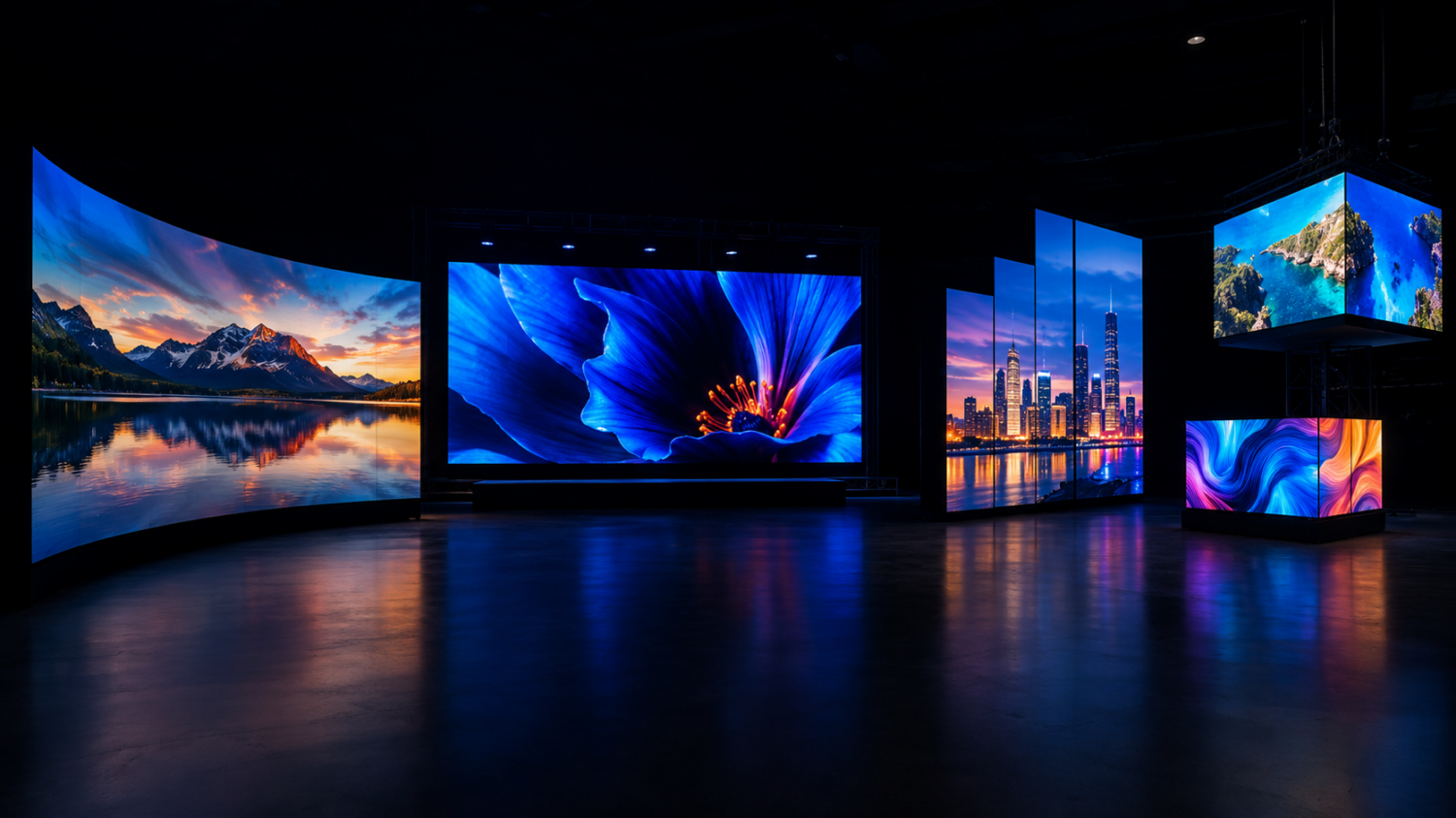
Walk into a modern broadcast studio, corporate lobby, concert, or trade show and chances are the biggest, brightest screen in the room is a direct view LED display. Over the last decade, direct view LED has gone from a specialty technology to a go-to choice for large, high-impact visuals, and terms like DVLED and dvLED video wall now come up in nearly every conversation about big-screen displays.
If you’re new to the technology, or comparing it with LCD walls and projection, this post explains how it all works. It covers:
- What direct view LED (DVLED) is
- A brief history of direct view LED displays
- How direct view LED differs from LCD and projection
- Key technical specs of a DVLED video wall
- Direct view LED use cases
- DVLED rentals: when renting makes sense
- How to choose the right DVLED wall
What Is Direct View LED (DVLED)?
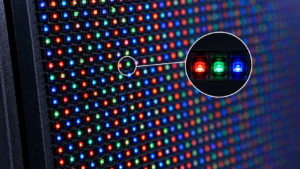
Direct view LED is a display technology in which the light-emitting diodes are the pixels themselves. Each pixel is a tiny cluster of red, green, and blue LEDs that produces its own light, so there is no backlight, no projector, and no screen surface for light to bounce off. You are looking directly at the light source, which is where the name comes from.
A direct view LED video wall is built by joining many modular panels (also called cabinets or tiles) edge to edge. Because the panels are modular, a DVLED wall can be almost any size, shape, or aspect ratio. It can be a wide 16:9 canvas, an ultra-wide ribbon, a curved backdrop, or a column. Once the panels are connected to a video processor, the whole assembly behaves like one seamless display.
You’ll also see the term “LED” used loosely for LED-backlit LCD televisions. They are different products. In a standard LED TV, the LEDs only light an LCD panel from behind. In a DVLED display, the LEDs create the image directly.
A Brief History of Direct View LED Displays
The story of direct view LED begins with the LED itself. The first visible red LED appeared in 1962, but full-color video had to wait until efficient blue LEDs arrived in the 1990s (work recognized with the 2014 Nobel Prize in Physics). With red, green, and blue available, LED pixels could finally produce moving images, and the first full-color DVLED walls appeared in stadiums and city centers.
Surface-mount packaging then shrank pixel pitch and cabinet size, bringing the direct view LED video wall indoors and into studios, trade shows, and corporate spaces. Today’s DVLED panels are brighter, thinner, lighter, and easier to service than ever, and newer approaches like mini-LED, COB, and micro-LED continue to push pixel density higher.
How Direct View LED Differs from LCD and Projection
Choosing a display technology usually comes down to how big the image needs to be, how bright the room is, and how close people will be standing. Here is how DVLED compares with the other common options.
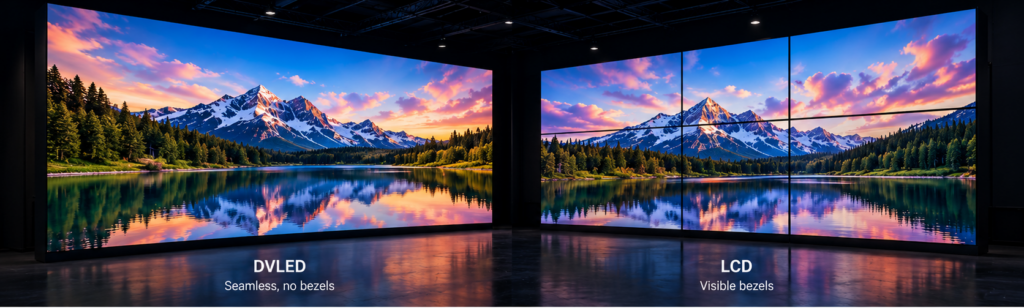
DVLED vs. LCD video walls. An LCD video wall tiles multiple LCD monitors together. Every monitor has a bezel, so the image is broken up by visible seams, and the LCD layers sit in front of a backlight, which limits brightness and contrast. A DVLED wall has no bezels, so the image is continuous. LCD can be a cost-effective choice for smaller, close-viewing installations, but as screens get larger, a direct view LED wall typically offers a cleaner, more flexible result.
DVLED vs. projection. Projectors rely on a dark room to look their best, and the image quality depends on the projector’s lumens, the screen surface, and ambient light. Shadows from people or objects crossing the beam can also interrupt the picture. A DVLED wall emits its own light, so it stays vivid in bright rooms, and nothing sits between the audience and the image.
DVLED vs. LED-backlit displays. As noted above, “LED TV” refers to an LCD with LED backlighting. Direct view LED is self-emissive: each pixel produces its own light, which allows true blacks when pixels are off, strong contrast, and brightness levels that are difficult to achieve with a backlit panel.
A quick summary of how they compare:
| DVLED Wall | LCD Video Wall | Projection | |
|---|---|---|---|
| Light source | Pixels emit light directly | LED backlight behind LCD | Lamp or laser, reflected off a screen |
| Seams | Virtually seamless | Visible bezels | Seamless (edge-blended) |
| Bright-room performance | Excellent | Moderate | Limited |
| Size flexibility | Nearly unlimited | Limited by monitor sizes | Limited by throw distance and light output |
| Shape options | Flat, curved, custom | Flat grids | Flat screens |
Key Technical Specs of a DVLED Video Wall
When you compare direct view LED displays, a handful of specifications do most of the work.
Pixel pitch. This is the distance, in millimeters, from the center of one pixel to the center of the next. Smaller pitch means more pixels per square foot and a sharper image at close range. A common rule of thumb is that the pitch in millimeters roughly matches the minimum comfortable viewing distance in meters. A 2.6mm panel, for example, looks good starting around 2.6 meters away.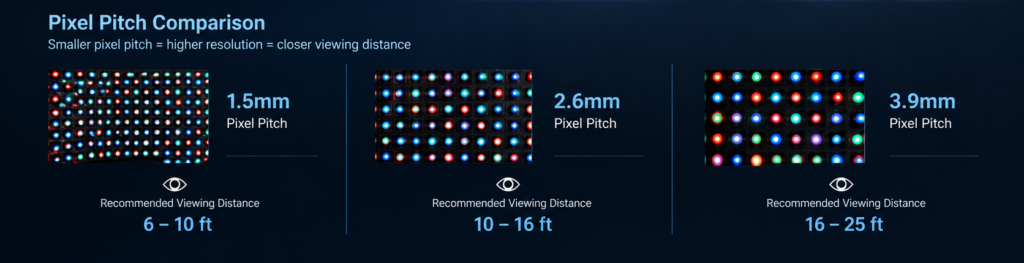 Brightness (nits). Indoor DVLED panels are typically run at a few hundred to roughly a thousand-plus nits, while outdoor panels need significantly more to stay legible in direct sunlight. Higher is not always better indoors, where an overly bright wall can be uncomfortable.
Refresh rate and scan rate. Higher refresh rates reduce flicker and banding, which matters for anything filmed on camera, such as broadcast, streaming, and virtual production.
Viewing angle. Quality panels maintain color and brightness from wide angles, so people at the sides of the room see the same image as those in the center.
Contrast and color. Because pixels can switch off completely, a DVLED wall can deliver deep blacks and high contrast, along with wide color gamut suited to demanding content.
Cabinet design and serviceability. Standard cabinet sizes, quick-lock hardware, and front or rear service access determine how quickly a wall can be built, repaired, and torn down. This matters a great deal for touring and rental work.
Processing. A video processor scales your sources to the wall’s native resolution, maps content across the panels, and manages calibration so brightness and color match across every tile.
Indoor vs. outdoor. Outdoor DVLED panels add weatherproofing, higher brightness, and structural considerations such as wind load. Indoor panels prioritize finer pixel pitch and close-up image quality.
Not sure how many panels your wall needs? Our LED calculator can help you estimate size and resolution.
Direct View LED Use Cases
Because a dvLED wall can be sized and shaped to fit nearly any space, it shows up in a wide range of settings.
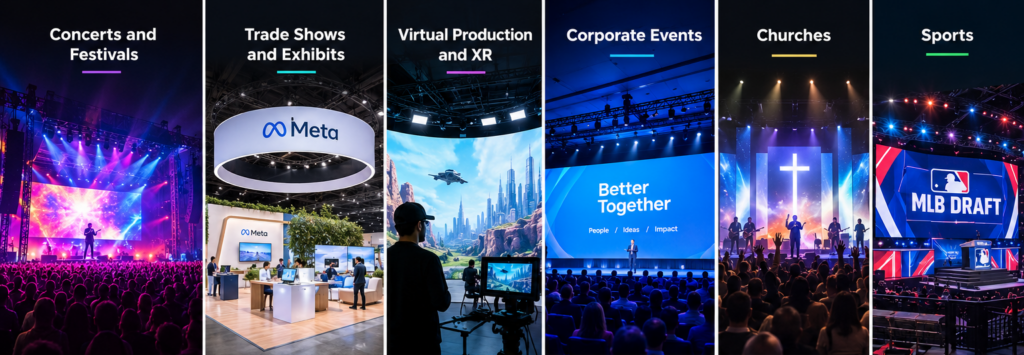 Concerts and Festivals
From backdrops and side screens to custom-shaped set pieces, DVLED is the foundation of modern live production. High brightness and durability make it a good fit for touring and outdoor stages. Explore our concert and festival LED solutions.
Trade Shows and Exhibits
A direct view LED video wall instantly gives a booth presence, whether it’s a back wall, a tower, or an eye-catching feature. Modular panels ship, build, and strike quickly. See our trade show LED displays.
Virtual Production, XR, and Broadcast
LED volumes and DVLED backdrops are used to display real-time environments behind talent, replacing green screens in many workflows. Brightness, color accuracy, and refresh rate are especially important here. Learn more about our virtual production and XR solutions.
Corporate Events and Environments
Product launches, general sessions, lobbies, command centers, and executive briefing rooms all benefit from the clarity and scale of a DVLED video wall.
Churches and Houses of Worship
Large LED walls give congregations a clear view of lyrics, scripture, announcements, and live camera feeds, with a look that suits the space. See our church and worship LED solutions.
Sports, Retail, and Digital Signage
Venues, storefronts, and public spaces use direct view LED displays for scoreboards, advertising, wayfinding, and branded experiences, with content that can change instantly.
Custom Builds
Curved walls, columns, ceilings, and irregular shapes are possible because of the modular design. Our custom LED video wall solutions cover projects that don’t fit a standard mold.
DVLED Rentals: When Renting Makes Sense
Purchasing a direct view LED video wall is a significant capital investment, and not every project calls for one. Renting a DVLED wall is often the better choice for events, tours, productions, and temporary installations. A rental typically offers:
- Lower upfront cost. You pay for the time you need rather than owning the equipment.
- Flexible sizing. Build a larger dvLED wall for the main event and a smaller one for the next.
- Current technology. Access maintained, tested equipment without worrying about storage, upgrades, or depreciation.
- Delivery, setup, and teardown. Experienced crews handle logistics, rigging, and load-out.
- On-site technical support. Technicians can run and monitor the wall throughout your event.
- Spare capacity. Rental inventory typically includes spare panels and backup gear to reduce downtime risk.
Rentals are a natural fit for trade shows, concerts, corporate events, product launches, broadcast and virtual production shoots, and seasonal installations. You can browse LED wall rental options by indoor or outdoor use, or explore panels from leading manufacturers such as ROE, Absen, and Unilumin. If you’d rather own, see our LED video walls for sale.
Pricing varies from project to project. Wall size, pixel pitch, indoor or outdoor use, rigging method, rental length, power needs, delivery, and crew support all affect the total, which is why a quote based on your specific details is the most reliable way to budget.
How to Choose the Right DVLED Wall
Before you reach out, it helps to have answers to a few questions:
- Where will it be? Indoor or outdoor, and in what kind of space?
- How close will the audience be? Viewing distance drives pixel pitch.
- How big should it be? Consider sightlines, available space, and structural limits.
- What content will you show? Live cameras, presentations, graphics, or video loops all influence the processing and control setup.
- Will it be on camera? If so, refresh rate and scan rate become priorities.
- How long do you need it? One day, a week, or a full season?
- What are the site conditions? Power, rigging points, load-in access, and weather all matter.
You don’t need every answer to get started. Working through the open questions is what the planning conversation is for.
Ready to Plan Your DVLED Video Wall?
Every project has its own requirements, and the best way to find the right direct view LED solution is to talk with people who design, build, and run them every day. Submit a request for a quote and our experts will review your project details and recommend the right DVLED wall for your event, venue, or production.